


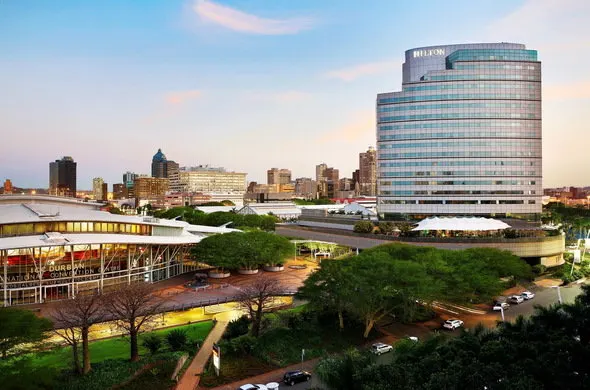
Radisson, Hilton, Ibis, Golden Tulip, Marriot – just to name a few international brands – are pushing and shoving to maintain their presence in the place the Economist described in 2000 as the “Hopeless Continent”.

As globalisation rears its ugly but smiling head, sweeping Africa off its feet and pushing capitalism to the limits, international hospitality companies want to “die together with Africa”.

The food and beverages sector is also closing in on “Africa Rising”, a nickname given to Africa by the Economist in 2011. Surprisingly, West-based companies are prepared to brave all sorts of risks associated with Ebola, armed conflict, xenophobia and Afro-pessimism, dictatorship, election violence and climate change, among others.
Hotel development pipeline in Africa grew by 14% in 2018, and has almost doubled since 2014, according to Lagos-based W Hospitality Group.
As if that was not enough, the announcement made this week by Keane Group at the 2019 Africa Hotel Investment Forum (AHIF) that 700 new hotel restaurants and bars will be opened in Africa by 2025 sent the chill down every African’s spine.
This year’s edition of AHIF took place on 23-25 September in Addis Ababa, the capital of Ethiopia.
Keane’s predictions are said to be based on its research into 410 food and beverage venues across 100 internationally branded hotels in Africa’s 10 major cities, as well as on the W Hospitality Group’s hotel development pipeline report.
AccorHotels, the owner of Novotel and Sofitel among others, is already operating 100 luxury hotels in Africa and Marriot intends to increase its Africa presence to nearly 40 000 rooms across 200 hotels.

Hilton announced recently that it was gearing up to open 100 hotels across Middle East and North Africa in the next five years. The investment will create over 25 000 jobs, according to Patrick Fitzgibbon, Hilton Senior VP for development in Europe, Middle East and Africa.
Stefan Breg, Keane Group strategy director, said: “Over the last 70 years, the restaurant market internationally has been built on three factors; growing towns and cities, broad distribution of income and a growing middle class.
“When you take into account that the anticipated rate of urbanisation, expected across Africa, will outpace India and China in the next 25 years, Africa will become one of the world’s most vibrant dining scenes.”
Keane is a food and beverage strategy and design firm with studios in the UK, Dubai, Bangkok and Florida.
“We look carefully at the market to determine the right number of food and beverage concepts,” Emma Banks, Hilton V-P food and beverage strategy and development for Europe, Middle Eeast and Africa, said:
“If a hotel is considering a third party partner, a good approach could be to trial the concept initially with a pop-up to gauge the market appetite before committing to a larger investment and commitment.”














Leave a Reply