


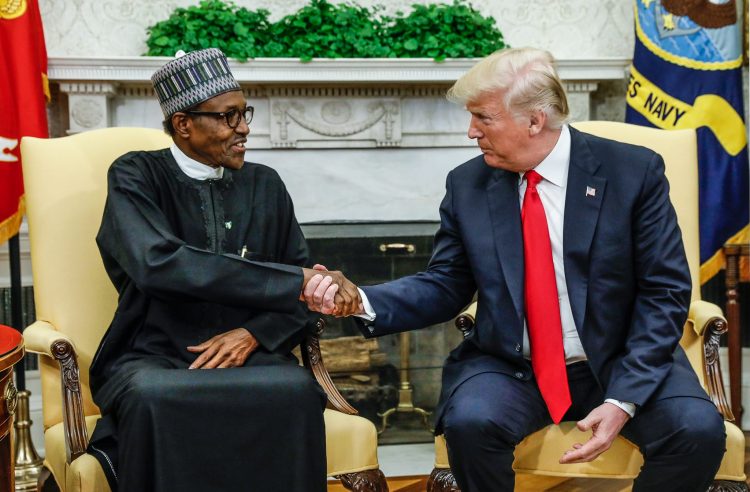
ABUJA: NIGERIA’S President Muhammadu Buhari has presented the 2020 budget proposal to a joint session of the country’s National Assembly (NASS).

Buhari, who addressed the joint session in Abuja at about, 2.03p.m., unveiled a budget of N10.33 trillion for the 2020 fiscal year.

He was accompanied by members of the Federal Executive Council (FEC).
The FEC had proposed N10.007 trillion for the financial year but the figure was increased to N10.33 trillion by the National Assembly.
Financial experts have hailed the President for the early presentation of the budget.
The president said the 2020 budget was designed to be a budget of “Fiscal consolidation to strengthen our macroeconomic environment; investing in critical infrastructure, human capital development and enabling institutions, especially in key job-creating sectors”.
According to Buhari, the budget was meant for “incentivising private sector investment essential to complement the government’s development plans, policies and programmes; and enhancing our social investment programmes to further deepen their impact on those marginalised and most vulnerable Nigerians”.
According to him, the expected total revenue in 2020 is N8.155 trillion, comprising oil revenue of N2.64 trillion, non-oil tax revenues of N1.81 trillion and other revenue of N3.7 trillion.
“This is seven per cent higher than the 2019 comparative estimate of N7.594 trillion inclusive of the Government Owned Enterprises,’’ he said.
Buhari said non-debt recurrent expenditure include N3.6 trillion for personnel and pension costs, an increase of N620.28 over the 2019 fiscal year figure.
“This increase reflects the new minimum wage as well as our proposals to improve remuneration and welfare of our police and armed forces,’’ he said.
He added that N2.46 trillion was earmarked for capital projects, inclusive of N318.06 billion in statutory transfers.
Other estimates are N556.7 billion for statutory transfers; N2.45 trillion for debt servicing and provision of N296 billion as a sinking fund.
He explained that the sinking fund would be used to “retire maturing bonds to local contractors”.
The 2020 budget is based on an oil production estimate of 2.18 million barrels per day, oil price benchmark of 57 dollars per barrel and an exchange rate of N305 to a dollar.
Other benchmarks are: real Gross Domestic Product (GDP), growth rate of 2.93 per cent while inflation rate “is expected to remain slightly above single digits in 2020’’
On sectoral allocation, the president said the Ministry of Interior would get N35 billion as against N569 billion in 2019, Defence (N100 billion), Education (N48 billion) and Health (N46 billion) for some key spending
He noted with delight the continued recovery of the nation’s economy as well as the increase in the foreign reserve from 23 billion dollars in 2016 to N42.5 billion dollars in August.

“This increase is largely due to favourable prices of crude oil in the international market, minimal disruption of crude oil production given the stable security in the Niger Delta region and our import substitution drive, especially in key commodities,’’ he explained
Some financial experts, who hailed the President for the early presentation of the budget, made the commendation in separate interviews on Tuesday.
Dr. Samuel Nzekwe, a former President of Association of National Accountants of Nigeria (ANAN), said early presentation of the budget was a welcome development that could boost economic activities in the country.
“If the annual budget is signed early, it will make the country to go back to January-December cycle which would have positively impacted on the economy by making funds available to contractors.
“People selling items of capital nature will start selling, which make the economy vibrant,” he said.
The former ANAN president advised Ministries, Agencies and Department to be available to defend their budget so as to ensure early passage of the budget.
He said the early presentation of the budget would make the nation to effectively measure its performance.
Nzekwe commended the National Assembly for approving the Medium Term Expenditure Framework for 2020 to 2022 on Oct.3.
Dr. Titus Okunrounmu, a former Director, Budgetary Department of Central Bank of Nigeria (CBN), described the development as the right step in the right direction.
Okunrounmu said that the development would bring about positive development on the economy.
Also, Executive Director, Conscience Nigeria, Mr. Tosin Adeyanju, has commended President Muhammad Buhari for the timely presentation of the 2020 budget to the National Assembly (NASS).
Buhari on Tuesday in Abuja presented a budget of N10.33 trillion for the 2020 fiscal year to the joint session of NASS.
Adeyanju said 2019 budget was probably the second to be presented in October since 2009.
He also commended the president for proposing substantive allocation to the education sector.
“Works and Housing has the highest allocation with N262 billion, while Education has N48 billion and Universal Basic Education Commission has N112 billion. When you combine the two you will discover that it is a good one for the education sector.
“If this is eventually passed and the fund is released and properly monitor by NASS through oversight, it will go along way to improve the education sector.”
The executive director also lauded the president for focusing on the completion of ongoing projects rather than initiating new ones that might also not be completed at the end of the fiscal year.
Adeyanju urged the National Assembly to ensure that the budget is passed on time, before the end of the 2019, to ensure the life cycle of the budget run from January to December.
He also hailed the assembly for pledging to work with the president in the consideration of the budget and its implementation.















Leave a Reply