


GABORONE – Botswana is going to the polls on October 23 to choose who will rule the southern African country for the next five years.
Botswana’s famous former president Ian Khama on Sunday threw his weight behind the opposition, a severe critic of his when he was leader, in a bid to remove his handpicked successor in the country’s upcoming elections.

Voters could break the leadership of the ruling Botswana Democratic Party (BDP) that has been in power since 1966 when Sir Seretse Khama became the country’s first president since it gained independence from Britain in 1966.
Earlier this year Khama dramatically deserted from the Botswana Democratic Party (BDP).
His departure and denunciation of President Mokgweetsi Masisi have thrown the party into an internal crisis ahead of a high-stakes general election on October 23.
I will never distance myself from the @TsholetsaDomi & the incredible legacy that our party has created for Botswana over the last 53 years. We have had some incredible successes in the past and we have had our fair share of disappointments too. #RebirthofTheBDP pic.twitter.com/Dv57YapyJr
— Dr. Mokgweetsi E.K Masisi (@OfficialMasisi) October 16, 2019
The vote will test the strength of the BDP after more than five decades in control of the diamond-rich country, which has a reputation as a beacon of stability in a troubled continent.
Khama, a 66-year-old former general whose father led the country to independence, had a bitter fall-out with his former deputy Masisi after he took office last year.
At a rally in his eastern home town Serowe on Sunday, Khama told thousands of supporters that the BDP which was co-founded by his father was dead.
“The party of the founding father of the republic is no more. It is dead,” he said according to Agence France-Presse.
“Let us go and vote BPF and UDC,” Khama said, referring to the Botswana Patriotic Front, a party formed by his allies who split from the ruling party, and the main opposition coalition Umbrella for Democratic Change.
He implored voters to cast their votes for the UDC in constituencies where the BPF was not fielding a candidate.

Khama even supported the UDC’s leader Duma Boko.
“Life will be good like before,” if voters elect Boko, he added.
It represents a remarkable turnaround from Khama’s time in office from 2008-2018 when the UDC was a fierce critic.
In the run-up to the 2014 election, Boko even claimed he was on a hit list of Khama’s party.
The former president has said he regrets having chosen “autocratic, intolerant” Masisi as he successor.
Khama is a traditional chief of Serowe, which sits in a central region that has been a traditional BDP citadel and could be critical in the elections.
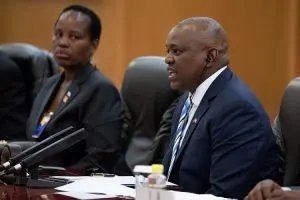
Transparency International has described Botswana as the least corrupt country in Africa. Masisi told Business Day that his presidency refuses to allow any type of corruption and is working hard to nip it in the bud.
“My administration does not tolerate corruption. All those who are implicated are investigated and those who should face prosecution will have their day in court,” he said.
After the confrontation with Masisi, Khama quit the BDP, the party his revered father had established, and in July formed his own party, the Botswana Patriotic Front. Khama appointed one of his former BDP followers, Biggie Butale as party president. Tshekedi(TK) remained in the BDP as minister of the environment but quit the BDP last week to join his brother’s party. However, the Weekend Post reported that TK was a founding member of the BPF, which would indicate he had a serious conflict of interest for the past few months.
Former President Festus Mogae said in an interview with The Voice, a Botswana daily, earlier in 2019 that Khama was “a strong-headed, manipulative and divisive character who throws tantrums if he does not get his way”.
Mogae said he had appointed Khama to succeed him to help unify the BDP, but instead he did the opposite. “Ian is nothing like his father, he is a disappointment,” he said.
Earlier in 2019, Khama accused Masisi of becoming a despot and threatening the country’s reputation as a beacon of stability in Africa.












Comments 1